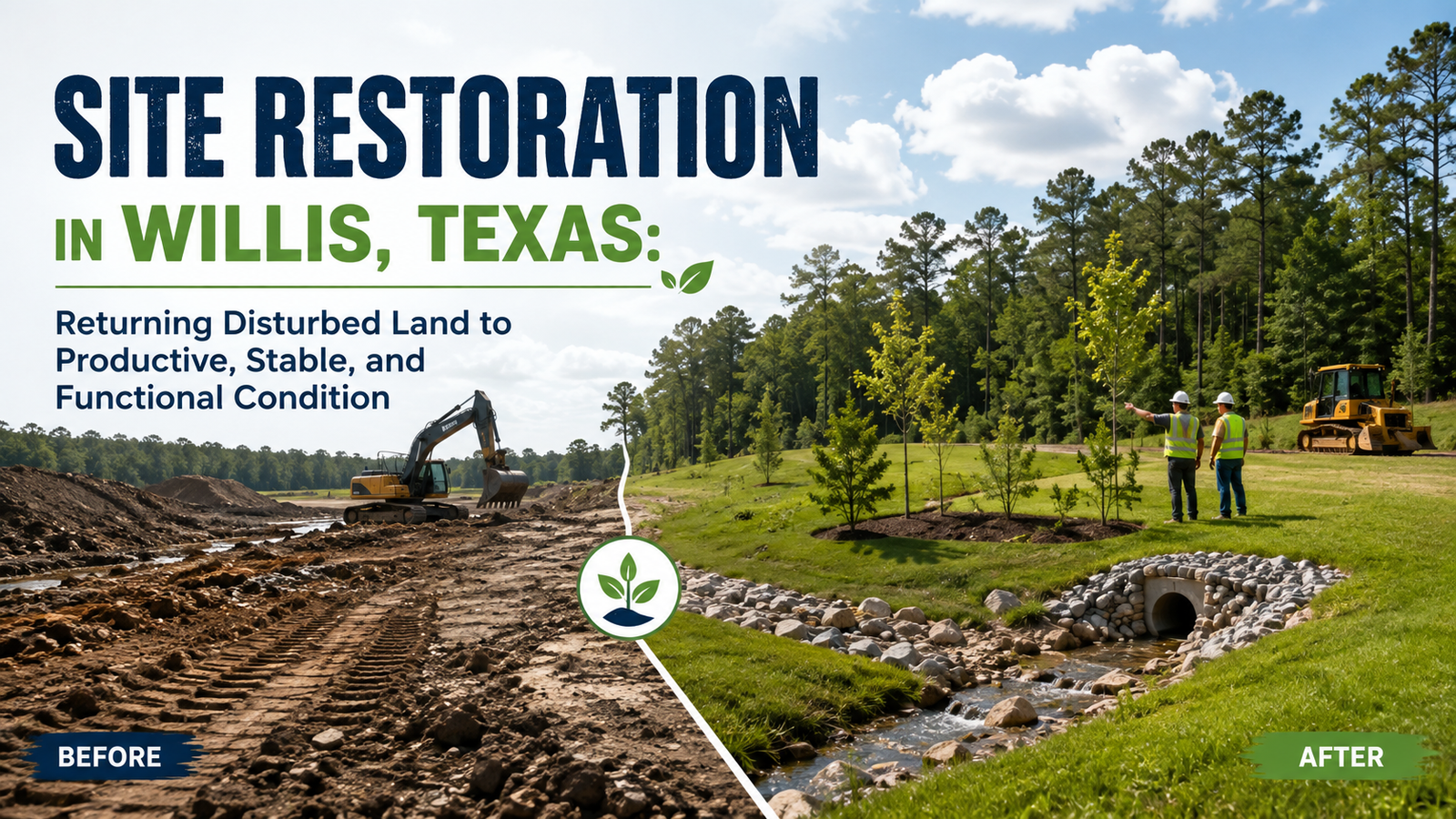
Every construction project, every demolition, every land clearing operation, every utility installation, and every significant ground disturbance leaves a site in a condition different from its pre-disturbance state. When the project is complete, or when a site is simply no longer being used for its original purpose, Site Restoration Willis is the process of returning the disturbed land to a defined functional state stable, properly draining, erosion-resistant, and biologically productive to the appropriate degree for the site’s intended future use. In Willis, Texas and the broader Montgomery County area, where the combination of intense rainfall, active land development, and the specific challenges of East Texas clay and loam soils create significant post-disturbance challenges, professional site restoration is as important as the original site work that preceded it.
What Site Restoration Involves and Why It Matters
Site restoration is not a single action but a collection of interrelated operations performed after the primary project work is complete. It addresses the condition in which disturbed sites are left the grading, drainage, erosion protection, revegetation, and environmental compliance that transform a disturbed site from a source of erosion, runoff, and weed pressure into a stable, functional piece of land.
The consequences of inadequate site restoration are significant and visible throughout the Willis area and broader Montgomery County. Improperly restored sites erode, depositing sediment into drainage ditches, detention ponds, and waterways. Ungraded, poorly draining cleared lots accumulate standing water that breeds mosquitoes, damages adjacent properties through uncontrolled runoff, and creates ongoing nuisance conditions for neighboring landowners. Cleared sites without revegetation become wildlife thickets of opportunistic pioneer species primarily yaupon holly, briars, and invasive grasses within a single growing season, requiring expensive re-clearing before the property can be used. These outcomes represent real costs and liabilities for property owners, and they are almost entirely preventable through appropriate site restoration work performed after primary project completion.
Site restoration in the Willis context encompasses several primary components: final grading and drainage correction, erosion control installation and maintenance, soil stabilization, revegetation appropriate to the site’s intended future use, and where required, environmental compliance documentation and monitoring.
Final Grading and Drainage Correction
The grading that occurs after clearing, demolition, or construction is complete is among the most consequential elements of site restoration. Grading establishes the permanent drainage patterns of the site the surface slopes that determine where water flows during and after rainfall events, where it concentrates, and where it exits the site or infiltrates the ground.
In Willis’s relatively flat terrain the topography of the northern Montgomery County area is gently rolling to flat, without the dramatic grade changes of more topographically diverse regions establishing positive drainage often requires deliberate grading rather than reliance on natural topography. A site that is simply cleared and left without intentional grading may have areas that pond water after every significant rain, creating the persistent wet conditions that are unfavorable for most land uses.
The minimum drainage gradient recommended for sites where water should not accumulate is typically 1 to 2 percent slope one to two feet of fall per 100 horizontal feet. In Willis’s rainfall environment, this is also approximately the minimum slope that will reliably shed water from a cleared area rather than allowing ponding. Final grading that achieves and maintains this minimum gradient across the restored site creates the baseline drainage performance that protects the site from the water-related problems that follow inadequate drainage.
Final grading also addresses any low spots, ruts, or irregularities created by equipment operation during clearing or construction. Equipment working on East Texas clay soils leaves compaction and surface disturbance that, without correction, creates uneven surfaces that collect water, resist vegetation establishment, and create hazards for anyone walking or operating equipment on the site. Finish grading with a box blade or road grader creates a smooth, compacted, uniform surface that supports revegetation and resists erosion.
Erosion Control: The Critical Restoration Step in Montgomery County
East Texas rainfall is intense and episodic. Montgomery County receives approximately 50 inches of annual precipitation, but a significant fraction of that total arrives in heavy storm events that deliver two, three, or more inches of rain in a matter of hours. Disturbed, bare soil exposed to these events without protection is highly vulnerable to erosion the rill and sheet erosion that strips the topsoil layer and deposits sediment into adjacent drainages.
Erosion control for site restoration in Willis begins with silt fence installation along the downhill perimeter of the disturbed area and across drainage pathways within the site. Silt fence permeable woven fabric secured to wooden or metal stakes allows water to pass through while trapping suspended soil particles, preventing sediment from leaving the site and entering drainage channels. For Willis sites adjacent to waterways or detention features, silt fence compliance is both a regulatory requirement under TCEQ’s Construction General Permit and a practical necessity for protecting adjacent properties and infrastructure.
Brush mulch applied to disturbed soil surfaces provides immediate protection against raindrop impact erosion the initial mechanism by which rainfall detaches soil particles and initiates erosion. A 2 to 3 inch layer of wood chip mulch or straw mulch on exposed soil dramatically reduces raindrop impact, slows surface runoff, and improves moisture retention for subsequent vegetation establishment. On Willis-area clearing sites where forestry mulching was used as the clearing method, the mulch already deposited by the mulching process provides this initial erosion protection without additional material import.
Hydroseed the spray application of a slurry of grass seed, fertilizer, soil binder, and water provides rapid vegetative cover on larger disturbed areas where conventional seeding would be inefficient. Hydroseed is particularly useful for roadside slopes, large cleared areas, and detention basin sideslopes that need fast vegetative establishment. In Willis’s warm growing season, warm-season grasses seeded by hydroseeding can achieve adequate cover within 30 to 45 days under favorable moisture conditions.
Revegetation for Willis-Area Site Restoration
Revegetation establishing plant cover appropriate to the site’s intended future use is the component of site restoration with the most variability in approach and the longest timeline for completion. The appropriate revegetation strategy depends entirely on what the site will be used for and what plant community is desired as the permanent cover.
For residential properties in Willis where a maintained lawn is the desired outcome, revegetation typically involves turfgrass establishment using bermudagrass, St. Augustinegrass, or zoysia sod or seed on the designated lawn areas. Bermudagrass establishes quickly and provides excellent coverage and durability for the East Texas climate. St. Augustinegrass is preferred by many Willis-area homeowners for its coarser texture and shade tolerance, though it requires sod installation rather than seeding.
For rural or agricultural properties, revegetation with forage grasses coastal bermuda, bahiagrass, or similar species establishes the grazing or hay production cover appropriate for livestock and ranch management. Forage grass establishment typically requires soil preparation (disking or tilling of the cleared ground), fertilization, and seeding followed by a period without grazing pressure to allow adequate root establishment.
For ecological restoration purposes which is an increasingly common goal for Willis-area landowners who want to restore native habitat rather than establish managed turf or pasture revegetation uses native plant species appropriate to the East Texas pine-hardwood transition zone. Native restoration seed mixes that include little bluestem, indiangrass, longleaf uniola, and wildflower species provide wildlife habitat, erosion control, and landscape character while requiring far less ongoing maintenance than conventional turf once established.
Texas Regulatory Requirements for Site Restoration in Willis
Texas environmental regulations create specific site restoration requirements for projects above certain land disturbance thresholds. TCEQ’s Construction General Permit (CGP) applies to construction-related land disturbance of one acre or more, requiring a Stormwater Pollution Prevention Plan (SWPPP) that addresses how erosion and sediment control will be maintained throughout the project and during the post-construction stabilization period. The SWPPP includes a requirement for final stabilization defined by TCEQ as the achievement of 70 percent vegetative cover over the disturbed area, or the application of permanent, non-vegetative stabilization measures before the CGP permit can be closed.
For Willis properties adjacent to waterways, wetlands, or other waters of the United States, additional regulatory requirements may apply under Section 404 of the Clean Water Act, administered by the U.S. Army Corps of Engineers. Activities that affect jurisdictional wetlands or waterways require permits, and site restoration in these areas must comply with the conditions of any applicable permits. Landowners uncertain about whether their property contains jurisdictional features should consult with a wetland delineator before beginning clearing or grading work.
Common Questions About Site Restoration in Willis
How quickly will vegetation regrow on a cleared Willis site without restoration? East Texas vegetation, particularly yaupon holly, will begin colonizing a cleared site within a single growing season. A site cleared in spring will typically show dense yaupon seedling growth by fall. Without active management or revegetation, a cleared site will return to dense brush within two to three years.
Is erosion control required by law for lot clearing in Willis, Texas? For projects disturbing one acre or more, TCEQ’s Construction General Permit requires a SWPPP with erosion control measures. Montgomery County may have additional requirements for certain project types or locations. For smaller disturbances, Texas law still requires that stormwater leaving a site not cause adverse impacts to adjacent properties or waterways, which practically requires erosion control even where not formally mandated.
Can site restoration be combined with the original clearing project? Yes, and this is often the most efficient approach. A clearing contractor who also provides site restoration services can sequence the restoration work immediately after clearing completion before vegetation regrowth begins, before significant erosion occurs, and while equipment is still on site. Combining clearing and restoration into a single mobilization reduces overall project cost and minimizes the period during which the site is unprotected.